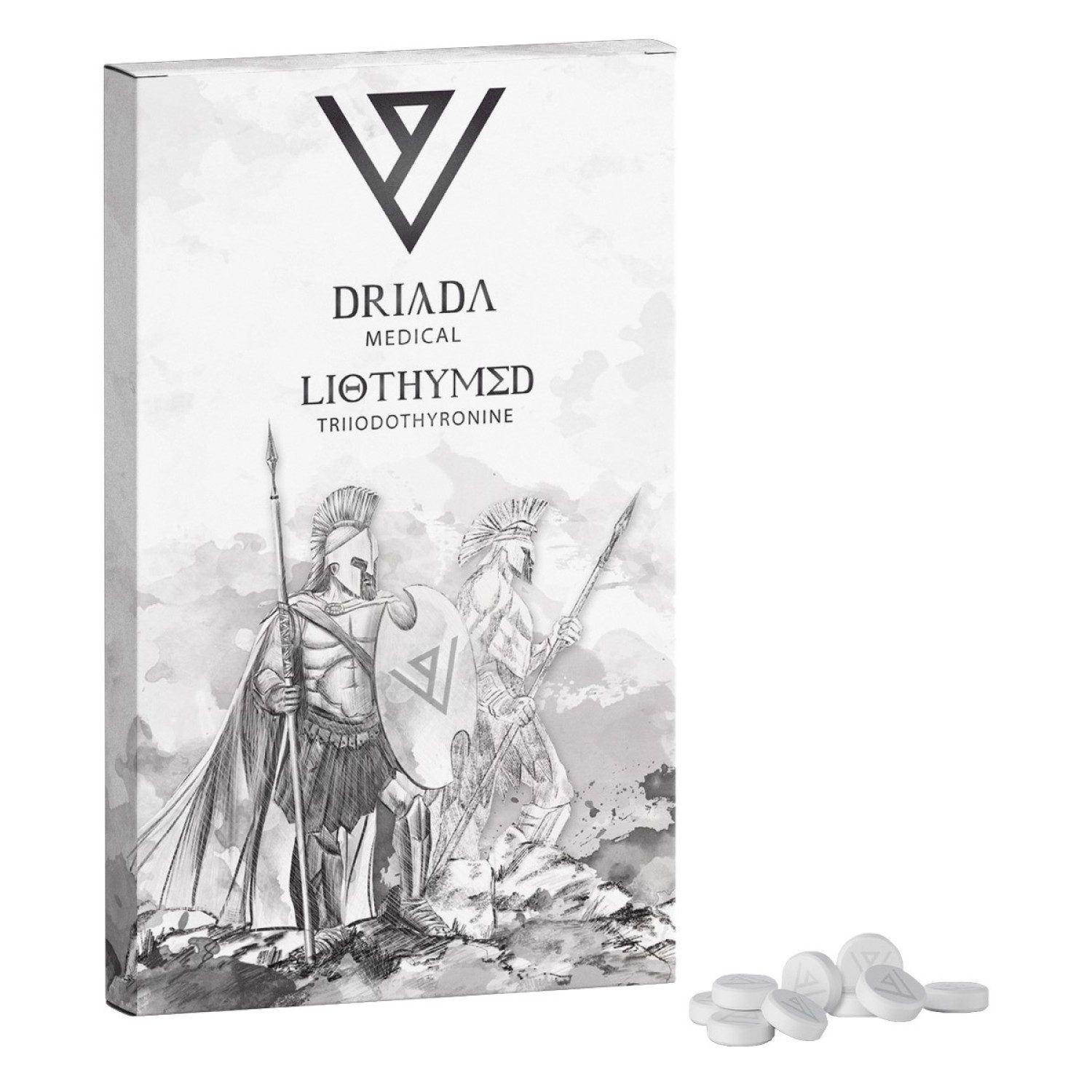
Liothymed 25 mcg (T3 – Triiodothyronine)
Triiodothyronine is an iodine-containing thyroid hormone that performs two essential functions. In growing bodies, it is crucial for normal development, especially of the central nervous system. In adults, it regulates metabolism and affects virtually all organs and tissues, controlling energy expenditure, rate, and volume.
The thyroid gland maintains significant reserves of thyroid hormones to fulfill these functions. While the liver primarily metabolizes thyroid hormones, some conversion also occurs in target tissues such as the brain. The adenypophysis finely regulates plasma thyroid hormone levels using thyroid-stimulating hormone (TSH) and negative feedback mechanisms. TSH signals the production of thyroid hormones, the primary hormone being T4, which can convert to the active T3 in tissues.
Thyroid hormones act mainly through intracellular receptors, which influence the expression of specific genes.
Mechanism of Action
According to current understanding, T3 binds to intracellular receptors, modifying their affinity for T3-sensitive regulatory elements that control gene expression. This modulation of gene expression affects protein synthesis. Typically, a free receptor binds to a regulatory element, suppressing the expression of the corresponding gene, although activation can occur in some cases. By binding to the receptor, T3 enhances or suppresses gene expression. T4 also binds to these receptors, but with a lower affinity than T3. However, the effect of T4 on gene expression has not been demonstrated, making it functionally a prohormone, since its conversion to T3 determines its impact on gene expression.
There are effective treatments for most thyroid conditions, and replacement therapy is commonly used to treat hypothyroidism.
In medical practice, T4 is usually prescribed. However, in sports, both T3 and T4 are used for different purposes.
Liothymed specifically activates the production of beta-2 adrenergic receptors in adipose tissue. The enzyme hormone-sensitive lipase (HSL) plays a crucial role in lipolysis. HSL activity requires epinephrine and norepinephrine (catecholamines). Liothymed stimulates beta-2 receptors, enhancing the ability of catecholamines to activate HSL and promote lipolysis.
Purposes of Use
Triiodothyronine (T3), or liothyronine, is primarily a thyroid hormone with fat-burning effects. It can also influence anabolic processes and stimulate the production of growth hormone (GH), contributing to increased anabolism in the body. Liothymed is commonly used for weight loss and shares a similar mechanism of action to thyroxine. However, T3 exerts a more potent influence on protein catabolism pathways than T4. When both substances are used for fat loss, T3 has a greater propensity to reduce muscle mass than T4. It should be noted that T3 is an active form of T4, resulting from the conversion of thyroxine.
T3 also promotes skeletal muscle growth by increasing the number and diameter of muscle fibers. It plays a role in the transition from neonatal to adult myosin isoforms.
Liothymed for Athletic Purposes
Athletes use Liothymed to boost their metabolic processes, achieving accelerated conversion of carbohydrates, proteins, and fats. It is particularly sought after for its fat-burning properties. Liothymed is often combined with various anabolic steroids to achieve a more powerful anabolic effect, leading to increased muscle mass. When used correctly, Liothymed can help achieve a balanced figure with substantial, strong muscles.
How to Use
Typically, the initial dose of Liothymed begins at 25 mcg per day and increases by 25 mcg every 5-6 days, up to a maximum of 100 mcg per day. The daily dose should be divided into multiple doses throughout the day. The maximum recommended cycle length is seven weeks, with at least six weeks between cycles. This approach ensures normalization of thyroid function. Combining Liothymed with clenbuterol can further enhance the fat-burning effects.
- Average dose: 25 to 100 mcg per day
- Effective dosage: pyramid method (25-50-75-100-75-50-25)
- Proven cycle length: 5-6 weeks
Effects
- Regulation of metabolism
- Increased fat burning
- Improved anabolic processes and muscle growth
Warnings
- Without anabolic assistance, T3 use can lead to significant muscle loss.
- Liothyronine can cause an increase in blood sugar levels, potentially affecting glucose tolerance and worsening diabetes. People with diabetes should carefully monitor their blood sugar levels and inform their doctor of any abnormalities.
- Starting treatment with liothyronine may place additional stress on the heart, especially in people with angina or other heart conditions. It is important for people with heart conditions to consult their pharmacist about the effects of liothyronine on their specific condition, dosage considerations, and the need for special monitoring.
- Liothyronine is safe for use during pregnancy.
- Liothyronine passes into breast milk in small amounts. Breastfeeding women should continue using thyroid hormone and inform their pharmacist if they plan to breastfeed or continue breastfeeding while taking liothyronine.
- Elderly people may be more sensitive to the effects of liothyronine and should be aware of potential adverse effects, especially those related to the heart.
Side Effects
- Chest pain, discomfort, or tightness
- Difficulty swallowing
- Extreme fatigue
- Fainting
- Fast, slow, irregular, pounding, or rapid heartbeat or pulse
- Heat intolerance
- Nausea
- Sweating
- Tremors
Profile
- Half-life: 6-24 hours
- Frequency of intake: 1-2 times a day
Contraindications
- Contraindicated in patients with untreated subclinical thyrotoxicosis (suppressed serum TSH level with normal T3 and T4 levels) of any etiology and in patients with acute myocardial infarction.
Conservation
- Keep out of reach of children
- Store in a cool, dry place, away from direct sunlight
- Store at room temperature
- Do not use after the expiration date

![T3 25 mcg [100 tablets] SuperHuman Pharma](https://eumusclelab.com/wp-content/uploads/2025/08/T3-1536x864-1-150x150.webp)




Reviews
There are no reviews yet.